New BTN documentary explores ACES’ remarkable history of agriculture

The University of Illinois Urbana-Champaign’s Morrow Plots — the oldest continuously running agricultural experiment in North America — celebrate their 150th anniversary this year. It’s a milestone for the College of Agricultural, Consumer and Environmental Sciences, symbolizing its commitment to the land-grant mission, effort to feed a global population, and goal of nourishing its own campus community. 

To commemorate the occasion, a new 30-minute documentary highlights the U. of I.’s rich history of agricultural innovation and discovery. “Rooted in Discovery: Agriculture at Illinois” premieres at noon Wednesday, July 8, on the Big Ten Network as part of the network’s Illinois Day. 

Stories in the documentary include:

Morrow Plots

To recognize its 150th anniversary, this segment explores the lasting impact of the Morrow Plots. Established in 1876, it is not only the oldest continuous experimental crop field in North America but the second-oldest in the world. Located in the heart of campus, this former patch of prairie has been cultivated year after year, generating invaluable data on soil health and agricultural sustainability that continues to inform researchers around the globe through a freely available dataset.

“Many parts of the world share a similar environment as the ‘Corn Belt of Illinois,’ and these regions stand to benefit from our communication. I’d argue that that goes both ways,” says Andrew Margenot, a professor in the Department of Crop Sciences and the director of the Morrow Plots. 

The RIPE Project

By 2050, the world’s growing population is expected to require 50-70% more food production to meet global demand. Realizing Increased Photosynthetic Efficiency (RIPE) at the U. of I. is tackling this challenge by leading an international research effort aimed at improving photosynthesis, the natural process plants use to convert sunlight into energy. From gene editing to canopy architecture, RIPE researchers hope to increase yields and help build a more sustainable food future, especially in countries in sub-Saharan Africa and Southeast Asia.

“While our focus is certainly on smallholder farms, we’re also making changes that we hope will benefit growers everywhere,” says Lisa Ainsworth, the director of RIPE and a professor in the Departments of Crop Sciences and Plant Biology. In addition to addressing food insecurity, the team is also developing solutions to help crops withstand the challenges of a changing climate.

Sustainable Student Farm

Founded in 2009, the Sustainable Student Farm is a unique 5-acre, student-run educational farm that grows a wide array of fruits, vegetables, herbs and flowers. Through low-input, environmentally sustainable growing practices, the farm provides students with hands-on experience in horticulture while teaching valuable skills in food safety, farm operations, infrastructure management and marketing, among many other aspects of sustainable food production. On Thursdays, a stroll across Illinois’ Main Quad will likely lead you to the farm’s stand — one of campus’s most popular destinations for fresh, seasonal produce.

“It really completes the full cycle of having grown this food from seed sometimes and getting to see who’s going to be eating that food,” says Matt Turino, the Sustainable Student Farm manager. About half of what is grown on the farm makes its way into Illinois dining halls, including 12,000 to 18,000 pounds of tomatoes each year, which are transformed into homemade pizza sauce.

“Rooted in Discovery” was produced by Kaitlin Southworth for the University of Illinois Urbana-Champaign’s Strategic Communications and Marketing.

Meet the ACES alum behind a transformative gift to revitalize the Morrow Plots

March 9, 2026 | Kylie Corral and Claire Benjamin

When Bayer’s Crop Science division Head of R&D Mike Graham returns to campus this week, he’ll be looking ahead to the future of agricultural innovation and the enduring value of land-grant research. Graham will join College of Agricultural, Consumer and Environmental Sciences Dean Germán Bollero for a fireside chat at the 11th Annual AgTech Innovation Summit, presented by Bayer, on March 10, at the Illinois Conference Center in Champaign. Registration to attend the Ag Tech Summit is free.

Graham’s visit comes at a defining moment for the college. As ACES marks the 150th anniversary of the Morrow Plots — the oldest continuous crop experiment in the Americas — Bayer’s Crop Science division is supporting their revitalization through a transformative gift. The investment underscores the enduring value of long-term agricultural research and the land-grant mission that continues to drive discovery from Illinois to fields around the world.

For Graham, the connection is both strategic and deeply personal.

Born in Australia, he moved with his family to India at age seven. After one year, they moved again, this time to Colombia. By the time Graham was 18, his family had migrated once more — now to the U.S.

That journey ultimately led him to the College of ACES, where he completed his doctorate in 1993.

Growing up, he witnessed his father’s career as a soil microbiologist, an influence that would shape his own interest in plant breeding and genetics.

“My dad had a passion to think about soil microbiology through the lens of how it benefits smaller farmers. My brother and I would sometimes be among his laborers who helped him with his research. We got a unique vantage point in understanding how science could bring value to a farmer, and that helped us get into crop science and agriculture,” Graham said.

After moving to the U.S., Graham first attended the University of Minnesota, where he earned his bachelor’s degree, and then pursued a master’s degree at the University of Delaware.

“After my master’s, I had experience in corn but was looking to gain experience in soybeans. The question was, where is one of the best places in the U.S. to get that experience? And the answer was the University of Illinois Urbana-Champaign. The university has some of the best knowledge in quantitative genetics across crops and also has a very strong, emerging capability in biotech, including molecular marker technology. And it’s only continued to grow,” Graham said.

Alongside the academic foundation that sharpened his expertise in crop sciences, Illinois also offered an unparalleled network of collaborators and mentors — connections that would shape the trajectory of his career.

“All this was incredibly valuable as I progressed in my career: people to connect with, people to work with, and learning about the importance of how you think about people and teams in the workplace,” Graham said.

“There are three things that I ask everybody: How do you face big, hard scientific problems at scale? How do you make sure they address a farmer’s problem? And how do you enable that by working across teams to bring it to fruition? Those have been the things that I love to do, and some of the things that the University of Illinois helped me with as I began my career. ACES taught me that I love the technical part of the work that we do, but I also love the people part.”

After graduation, Graham began his career at Asgrow Seed Company. Following the company’s acquisition by Monsanto, he went on to serve as Director of Trait Field Solutions, Director of North America and Europe Plant Breeding, and eventually Vice President of Global Plant Breeding. 27 years after joining Asgrow, Graham is now the head of research and development at Bayer, which acquired Monsanto in 2018.

“Being in a position where I can think about both the next generation of product and solutions — but also how to help individuals and teams with their career or what they can achieve and how they can do more — has been so enjoyable for me,” Graham said.

“So far, I’ve spent a lot of time getting to know people in the organization, understanding where they are, what their concerns are, and what we could be doing better. I’ve also been learning a lot about crop protection, which is a big part of the organization today.”

Even as his career has advanced, Graham has remained closely connected to Illinois and the College of ACES, and indeed, the most historic research field in the U.S. “It was an easy decision to say, ‘Yes, let’s celebrate and commemorate the Morrow Plots,’” Graham said, referring to Bayer’s gift to revitalize the Morrow Plots in their 150th year.

For Graham, his time at ACES was an amazing moment in his career when “all the doors were wide open to explore and learn,” he said. “I hope current students will always take advantage of being and learning at Illinois, because nobody will ever say no. Be willing to share your perspectives and always be thoughtful about how it gets applied to solving problems.”


As the College of ACES celebrates 150 years of the Morrow Plots, we invite you to be part of this milestone year — attend events, explore the stories of discovery, and follow along as we look ahead to the next chapter of land-grant innovation. You can also make a lasting impact by supporting the Morrow Plots with a gift that helps preserve this living laboratory and advance research that serves farmers, communities, and global food systems for generations to come. Join us in celebrating — and investing in — the next 150 years.

ACES marks 150 Years of the Morrow Plots, our nation’s oldest research field

February 20, 2026 | Lauren Quinn

A lot has changed on the University of Illinois Urbana-Champaign campus since its founding in 1867, but a storied plot of land near the south quad has been preserved nearly intact for a century and a half. The Morrow Plots, famed in song and story, represent the oldest continuously running agricultural experiment in North America, and are the second oldest in the world. And this year, they turn 150.  

“The Morrow Plots are a huge part of our story in the College of ACES. They’re a direct example of how we live out our land-grant mission, providing evidence-based recommendations that serve the public,” said Germán Bollero, dean of the College of Agricultural, Consumer and Environmental Sciences at Illinois. “We’re so excited to celebrate 150 years of agricultural research and outreach that the Morrow Plots represent.”

It’s not an overstatement to say the Morrow Plots have directly impacted the way Americans farm. When the plots were established, farming was more of an art than a science. But methodical, controlled experiments in the plots proved certain practices — crop rotation and judicious fertilizer use — were winners for boosting crop yield, soil health, and farm profitability. 

With the advent of University of Illinois Extension in 1914, another key milestone, results from the plots were shared with farmers to implement across the state and beyond. 

“None of this would have been possible without the foresight of early campus leaders, who saw the value of long-term, practical research. This perspective allowed researchers to understand how farming practices shape soil, crops, and ecosystems over decades, not just seasons,” said Adam Davis, head of the Department of Crop Sciences, which oversees the Morrow Plots. “Together, these insights continue to inform strategies that sustain productivity while protecting natural resources.”

Something to Celebrate

In the centennial year of the experiment, the Morrow Plots were designated as a National Historic Landmark. In 2023, the plots’ data were digitized and made available online; the database includes crop hybrid, rotation, planting date and density, harvest date, and yield, as well as fertilizer type and amount. 

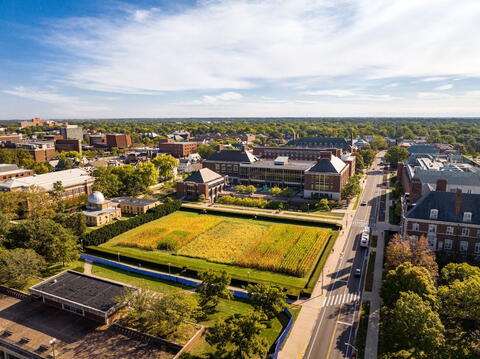
Aerial view of U. of I. campus showing the Morrow Plots at center
The Morrow Plots today. Image by Andy Savage.

Now in 2026, the college celebrates the Morrow Plots’ 150th anniversary with a revitalized exterior, thanks to a gift from Bayer’s Crop Science division; a dedicated webcam where viewers can check out activities in the plots year-round; and a public tour and symposium scheduled for Oct. 28, along with other events throughout the year. 

The October event will also formally unveil the Alma Mater Plots, an 80-acre parcel in the university’s south farms that carries the Morrow Plots’ research focus into the current era. A large focus of the Alma Mater Plots is accounting for tile drainage in cropping system performance, both as a tool and as a conduit for water and nutrient export. 

“The Morrow Plots will be completing its 150th harvest this season. What will be the challenges facing agriculture in the next 150 harvests?” said crop sciences associate professor Andrew Margenot, director of the Morrow Plots and the Alma Mater Plots. “While we cannot anticipate the nature and extent of these challenges, we can design a long-term experiment that expands on the knowledge built from the Morrow Plots in a way that can flexibly address the challenges to come. In other words, it’s the ‘Morrow Plots 2.0.’”

Sign up for updates about the revitalization project and anniversary events. To learn more about supporting this legacy and helping shape the next 150 years of agricultural innovation, please contact the College of ACES Office of Advancement at acesadvancement@illinois.edu or 217-333-9355.

Research and Extension in the College of ACES are made possible in part by Hatch and Smith-Lever funding, respectively, from USDA’s National Institute of Food and Agriculture.

Bayer gift launches Morrow Plots revitalization for 150th anniversary

September 24, 2025 | Claire Benjamin

A gift from Bayer’s Crop Science division will support the revitalization of the University of Illinois Urbana-Champaign‘s Morrow Plots, the oldest experimental agricultural fields in North America. Established in 1876, the plots have become a national symbol of agricultural innovation and remain a National Historic Landmark. The revitalization project will coincide with their 150th anniversary, with completion timed for sesquicentennial celebrations in 2026.

College of Agricultural, Consumer and Environmental Sciences Dean Germán Bollero announced the plans at Celebrate Food and Ag Day on Sept. 13, 2025, marking the beginning of a transformative effort to reimagine this historic site.

“This revitalization honors the extraordinary legacy of innovation that has defined the Morrow Plots for 150 years,” Bollero said. “We are deeply grateful to Bayer for investing in this project and for joining us in ensuring these fields remain a source of discovery and inspiration for generations to come.”

Overgrown shrubs that had surrounded and obscured views of the plots will be removed this fall to make way for a new landscape design. A live webcam will be set up to document progress. 

“Bayer is honored to support the preservation of the Morrow Plots, which represent a cornerstone of agricultural research and innovation,” said Masha Trenhaile, head of university strategy and outreach at Bayer’s Crop Science division. “We see this project not only as an investment in a historic landmark, but also as a tribute to the scientific progress and partnerships that will carry agriculture forward.”

For Bayer and its Illinois alumni, the project underscores both a proud history and a vibrant future.

“The Morrow Plots are more than fields — they’re part of our identity as Illinois graduates and as agricultural innovators,” said Mike Graham, ACES alumnus and head of research and development for Bayer Crop Science. “For me personally, it’s an honor to help ensure this landmark is preserved and reimagined during its 150th year. When I was at ACES, all the doors were open to explore and learn, and I’m proud that Bayer can help provide that same inspiration for future generations.”

The Morrow Plots are stewarded by the Department of Crop Sciences in the College of ACES — under the leadership of department head Adam Davis and Andrew Margenot, associate professor of soil science and director of the Morrow Plots — to ensure the fields remain both a living laboratory for research and a symbol of Illinois’ enduring contributions to agriculture.

The revitalization work will continue throughout the 150th year of the Morrow Plots and be completed in time for the sesquicentennial celebrations in 2026. More details will be shared in the coming months, and the public can sign up for updates about the revitalization project and anniversary events.

To learn more about supporting this legacy and helping shape the next 150 years of agricultural innovation, please contact the College of ACES Office of Advancement at acesadvancement@illinois.edu or 217-333-9355.

Oldest US agricultural plots go digital: 130+ years of data now online

April 20, 2023 | Lauren Quinn

In 1876, when University of Illinois professor Manly Miles established the Morrow Plots, he couldn’t have imagined the plots would become the oldest continuous agricultural experiment in the Western Hemisphere. Nor could he imagine, more than a century before the dawn of the internet, that the plots’ data would be digitized and made available online to scientists, students, and educators around the world.

The new database, which includes crop hybrid, rotation, planting density, and yield, as well as fertilizer type and amount, came together thanks to the Morrow Plots Data Curation Working Group, an interdisciplinary team from the College of Agricultural, Consumer and Environmental Sciences (ACES) and the University Library at U of I.

Data scientists and curators not only had to find the historical data, including in an ancient notebook held by the Department of Crop Sciences, they had to standardize it through time so that year-to-year comparisons could be made. For example, some data were missing for certain years and yield wasn’t recorded at all until 1888. Thankfully, the working group was up for the challenge.

Professor Sandi Lee Caldrone (left) joins research technician Maia Rothman (center) and Associate Director of Information Technology Josh Henry. Credit: Fred Zwicky / University of Illinois Urbana-Champaign

Sandi Caldrone, assistant professor and University Library research data librarian, says, “The data were all in slightly different formats and needed a lot of finagling to get them to line up. My role was doing the coding required to clean up and combine those data sets and get it ready to publish. I also did a lot of the accompanying documentation that explains how we did it for folks who want to use the data or reproduce our work.”

Josh Henry, associate director of information technology for ACES, initially kick-started the project in 2018 as an example for faculty wanting to curate their own research data. As few faculty have such long and complex datasets, he knew if the working group could pull it off with the Morrow Plots data, anyone could do it.

“We learned a lot of lessons about how to deal with really messy data,” Henry says. “We now feel confident explaining what challenges have to be met in order to take something that was perhaps less useful and turning it into something that will be valuable for the future.”

Prior to the database’s publication, Andrew Margenot was fielding dozens of requests for the Morrow Plots data each year. Now he can direct those requests to the Illinois Data Bank.

“I’ve gotten requests from government and university researchers, both in the U.S. and abroad. They’re mainly modelers trying to link weather patterns with yield and soil data; a lot of modelers salivate at the Morrow Plots data,” says Margenot, assistant professor in crop sciences. “We also get requests from folks trying to understand how their long-term trials compare with ours.”

Margenot says the data can also be used to understand how soil fertility is influenced by management practices of crop rotation and nutrient inputs, and how this relates to crop yields. After discovering a trove of historic soil samples from the Morrow Plots and other sites around Illinois, Margenot is eager to analyze long-term trends.

Caldrone hopes the data can also be used for educational purposes.

“Students in every field need to learn how to work with data now,” she says. “As instructors need to find datasets to work into their classes, I would love to see people using the Morrow Plots data. It’s a longitudinal data set, and I think students in any field can get a grasp of the basics of planting, fertilization, and yield. And then, for U of I students, they learn a little bit more about their university history.”

The Morrow Plots started as an experiment to test the effects of crop rotation on soil quality, but along the way, they helped establish a number of farming basics we take for granted today, including that crops require nitrogen, phosphorus, and potassium; hybrid corn can boost yield, especially when planted at close spacing; and crop rotation can mean less need for fertilizers.

“The lesson of the Morrow Plots is clear: conserve the soil and maintain proper soil fertility to sustain food production for future generations,” says Robert Dunker, ACES agronomist and field trials coordinator. “Results from the Morrow Plots have given insights on how crop production systems respond to rotation and soil fertility, shaping farming practices to this day. While the Morrow Plots have become a significant historical site, they remain a continuing opportunity for researchers and student education.”

Morrow Plots
1102 S. Goodwin Ave
Urbana, IL 61801
217-333-0460